Practice your CFA Level II Chartered Financial Analyst certification test with free CFA-Level-II exam cram and take control of your certification preparation. At FreeExamCram, you can practice online for free using real CFA-Level-II exam dumps, verified questions, and expert-designed free online practice tests. Moreover our CFA Institute CFA-Level-II exam cram backed by our confidence-boosting refund guarantee.
Frank Hoskins and Paul Lanning are economists for a large U .S . investment advisory firm. Platinum Advisors. Hoskins and Lanning use their independent research on U .S . stocks and international stocks to provide advice for the firm's network of advisors. As the senior economist at Platinum, Hoskins is a partner in the firm and is Lanning's supervisor. Lanning has worked for Platinum for the past four years. At a lunch meeting, the two economists discuss the usefulness of economic theory, economic data, and the resulting forecasts of the global economic and stock market activity.
Hoskins is investigating the growth prospects of the country of Maldavia. Maldavia is a formerly communist country with a population of 3 million located in Eastern Europe. The Maldavian government had been aggressive in instituting political reform and encouraging the growth of financial markets. However, due to a recent insider trading scandal and resulting stock market volatility, the Maldavian government is considering restrictions on further stock market growth and the establishment of a national securities regulator. Hoskins states that these developments are not encouraging for future economic growth.
Lanning is examining the country of Petra. Petra is a country of 25 million located in South America and rich with natural resources including oil. The recently elected president of Petra, Carlos Basile, has announced that he would like to diversify the country's economy away from natural resources while nationalizing the oil industry. Lanning states that these changes would not be beneficial for the future growth of the Petrian economy.
One of the many items they study when examining an economy or stock market is the economic information released by governments and private organizations. Hoskins and Lanning use this information to determine the effects on economic growth and the appropriate portfolio allocations to the bond and stock markets. Examining information for Maldavia, Hoskins has learned that the Maldavian private sector has embarked on an ambitious plan to increase labor productivity by purchasing more machinery for its factories. The private sector feels compelled to do this because Maldavia has historically relied too heavily on labor as the main input into production. Plotting the productivity curve for Maldavia, Hoskins states that labor productivity should increase because the productivity curve will shift upward and to the right.

Emily De Jong, CFA, works for Charles & Williams Associates, a medium-sized investment firm operating in the northeastern United States. Emily is responsible for producing financial reports to use as tools to attract new clients. It is now early in 2009, and Emily is reviewing information for O'Connor Textiles and finalizing a report that will be used for an important presentation to a potential investor at the end of the week.
Following an acquisition of a major competitor in 1992, O'Connor went public in 1993 and paid its first dividend in 1999. Dividends are paid at the end of the year. After 2008, dividends are expected to grow for three years at 11%: $2.13 in 2009, $2.36 in 2010, and $2.63 in 2011. The average of the arithmetic and compound growth rates are given in Exhibit 1. Dividends are then expected to settle down to a long-term growth rate of 4%. O'Connor's current share price of $70 is expected to rise to $72.92 by the end of the year according to the consensus of analysts' forecasts.


Yi Tang updates several economic parameters monthly for use by the analysts and the portfolio managers at her firm. If economic conditions warrant, she will update the parameters even more frequently. As a result of an economic slowdown, she is going through this process now.
The firm has been using an equity risk premium of 5.6%, found with historical estimates. Tang is going to use an estimate of the equity risk premium found with a macroeconomic model. By comparing the yields on nominal bonds and real bonds, she estimates the inflation rate to be 2.6%. She expects real domestic growth to be 3.0%. Tang does not expect a change in price/earnings ratios. The yield on the market index is 1.7% and the expected risk-free rate of return is 2.7%.
Elizabeth Trotter, one of the firm's portfolio Managers, asks Tang about the effects of survivorship bias on estimates of the equity risk premium. Trotter asks, 'Which method is most susceptible to this bias, historical estimates, Gordon growth model estimates, or survey estimates?'
Tang wishes to estimate the required rate of return for Northeast Electric (NE) using the Capital Asset Pricing Model (CAPM) and the Fama-French three factor model. She is using the following information to accomplish this:
* The risk-free rate of return is 2.7%.

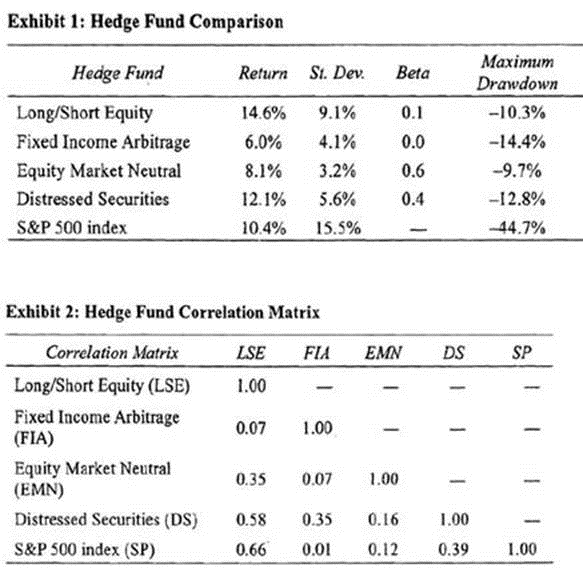
Chris Darin, CFA, works as a sell-side senior analyst and vice president for a large Toronto brokerage firm researching mainly hedge funds and alternative investments. Darin recently hired Simon Nielsen for the position of junior analyst at the firm. Although Nielsen does not have experience evaluating hedge funds, Darin hired him mainly for his previous experience at a discount brokerage firm and for his passion for the industry. Darin frequently mentors Nielsen on market trends, investment styles, and on risks inherent in alternative investment vehicles. In a recent conversation, Darin makes the following statements:
Statement 1: One way to measure hedge fund investment performance is through Jensen's alpha. A portfolio with negative Jensen's alpha would plot above the Security Market Line (SML).
Statement 2: Both the Sharpe ratio and Jensen's alpha can be used to measure risk-adjusted hedge fund returns. Oneof the advantages is comparability between the two methods since both calculate return relative to systematic risk.
Their conversation later shifts to discussing hedge fund classifications and how derivatives affect hedge fund performance measurement. Nielsen mentions that put options are often more advantageous than short selling in a market neutral strategy because of their asymmetric returns.
The following week Darin asks Nielsen to research potential problems and biases in hedge fund indexes and general risks inherent in investing in hedge funds. Nielsen compiles the information and presents the following findings:
1. One of the data problems in hedge fund indexes is that managers often do not disclose negative fund performance.
2. The historical performance of hedge funds that are recently added to an index is often added to the past performance of the index.
3. Long/short equity hedge funds are subject to equity market risk. This risk is typically greater than with equity market neutral or risk arbitrage funds due to the higher standard deviations and market correlations inherent in long/short funds.
4. Fixed income arbitrage funds are also subject to equity market risk. These funds are short Treasuries and long high-credit-risk bonds. In an economic downturn the short position in Treasuries provides a buffer against the long position and provides a net gain.
Finally, the two discuss the risk-free rate and various risk measures in hedge fund performance evaluation. Darin explains that even in market neutral strategies, the risk-free rate may not be an appropriate measure of fund performance. Nielsen does not understand and asks him to clarify. Darin further states that risk measures such as Value at Risk have several limitations as a risk measurement tool.
Nielsen's findings on long/short equity funds and fixed income arbitrage strategies, respectively, are:
© Copyrights FreeExamCram 2026. All Rights Reserved
We use cookies to ensure that we give you the best experience on our website (FreeExamCram). If you continue without changing your settings, we'll assume that you are happy to receive all cookies on the FreeExamCram.


 Full Access to 713 Questions